
ProLearners · Pilot
School Learning Lab
Discover the learning hidden in everyday life.
Big discoveries begin with little questions. Explore stories, solve everyday puzzles and try ideas for yourself, from Class 1 to Class 12.
For children and young people, and the grown-ups and teachers who learn beside them.
Choose your class
Tap a class. The picture, the question and the activity change to match.
Class 1 · Toy shop counting
How many cars are on the front shelf?
आगे वाली शेल्फ़ पर कितनी गाड़ियाँ हैं?

Class 2 · A dated plant diary
Which picture comes between the seed and the flower?
बीज और फूल के बीच कौन-सी तस्वीर आती है?
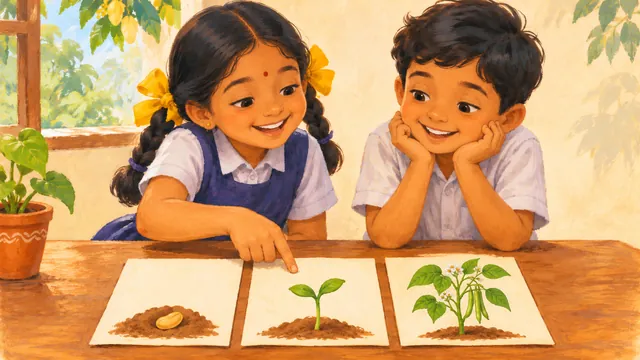
Class 3 · Plan a reading corner
Where would you put a cushion so a friend can still reach the books?
तकिया कहाँ रखोगे, ताकि दोस्त भी किताबों तक पहुँच सके?

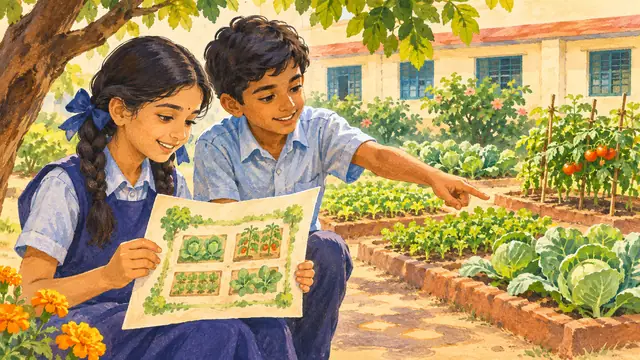
Class 4 · Draw a map with a key
Can you find the tomato bed on the map and in the garden?
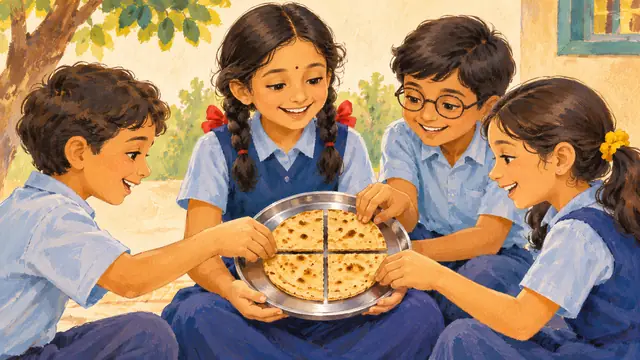
Class 5 · Fair shares: fractions with roti
Four friends share one roti equally. What fraction does each friend get?
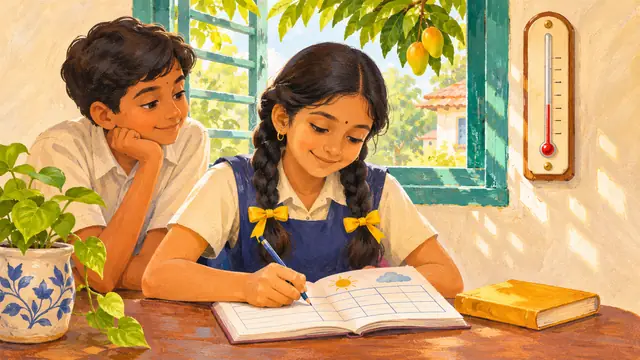
Class 6 · The temperature diary
One winter morning in Leh it is −8 °C. By the afternoon it is 4 °C. How many degrees did it warm up?
Morning: minus 8 degrees Celsius. Afternoon: 4 degrees Celsius.
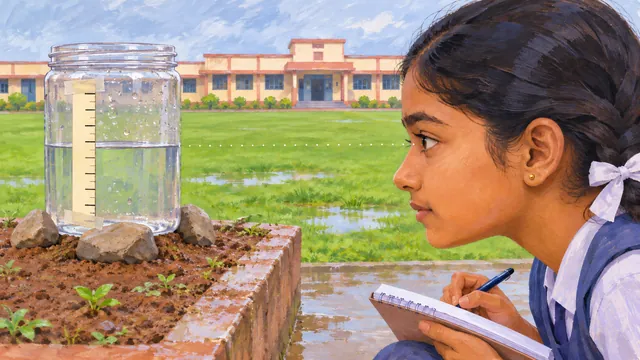
Class 7 · Make a rain gauge and record rainfall
The weather report says "15 mm of rain fell". What does that mean, and could you measure it yourself?
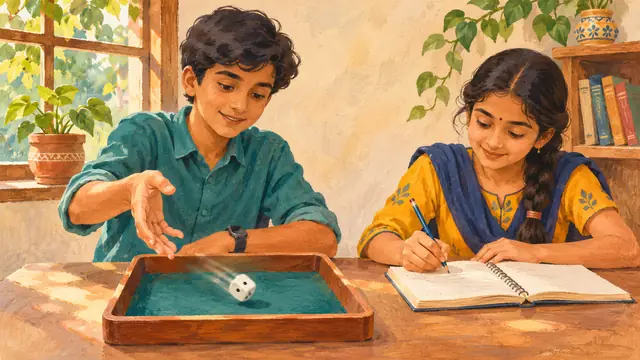
Class 8 · How likely? Chance with coins and dice
If you roll a fair die 60 times, must you get exactly ten sixes?
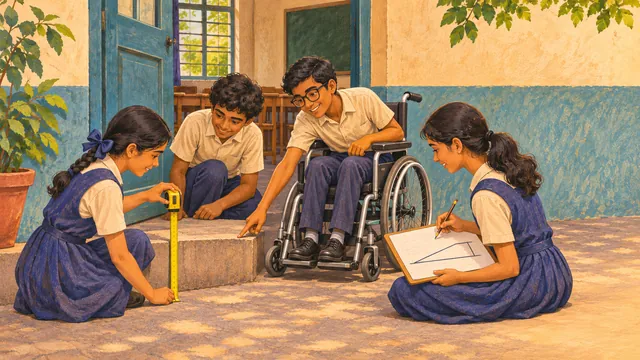
Class 9 · Design an accessible ramp
A classroom has a 15 cm step at the door. How long must a ramp be so that a wheelchair user can get in safely?
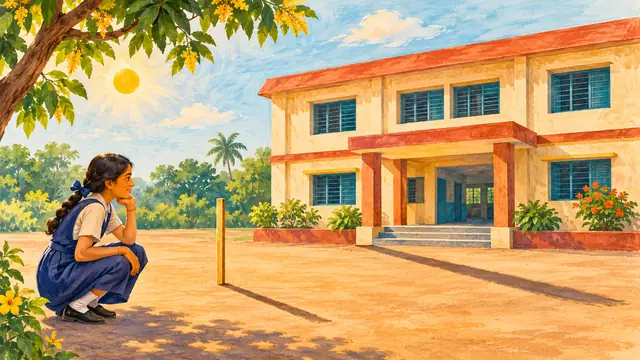
Class 10 · How tall is the flagpole? Ask its shadow
A stick and the school building both cast shadows. How could the two shadows tell you the building's height?
In the activity, a 1.5 m stick casts a 2 m shadow while the flagpole casts an 8 m shadow at the same moment, so the flagpole is 6 m tall. The same method works for the building.
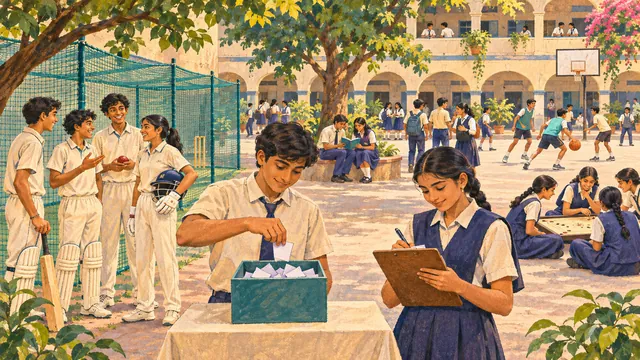
Class 11 · Sampling: who did you ask?
The cricket team was asked, and 87% want more cricket nets. Does the whole school want them?
Class 12 · Check a result a second way
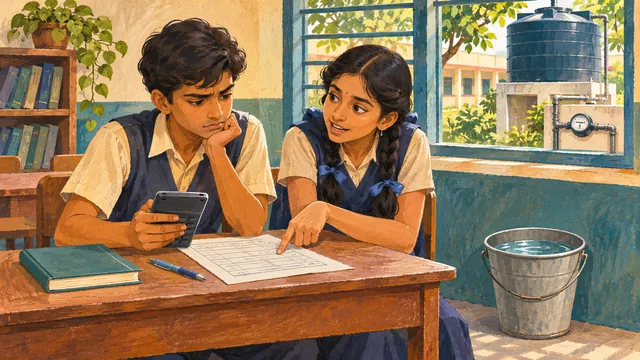
Your calculation says each student uses 3,000 litres of water a day at school. Would you believe it?
Or look at a whole stage
Explore a subject
Each subject shows what every stage covers, from Class 1 to Class 12.
Try a 2-minute puzzle
Dadi says she cut a roti into quarters. Which roti did she cut?
Tap a roti to see if you are right. You can tap the other one too.
Roti A
Not quite. Roti A has four pieces, but they are not the same size, so they are not quarters.
Roti B
Yes! You noticed every piece is the same size. That is what makes them quarters.
How every activity works
- 1. NoticeSpot something in everyday life.
- 2. GuessSay what you think will happen.
- 3. TryTest it with your hands.
- 4. ObserveLook closely. What really happened?
- 5. ExplainTell someone why you think it happened.
- 6. Ask another questionWhat would you like to try next?
Why science and maths?
Science and maths are more than facts and formulas. Done this way, they give children a toolkit for thinking: looking at evidence, reasoning step by step, and finding a way through a problem they have never seen before.
- Questioning and checking (critical thinking)
Asking "Is this true, and how do we know?" In science, appearances can deceive: a 90 g lemon floats while a 60 g potato sinks. In maths, a guess has to be checked. Children learn to look at the evidence, not at who said it or how sure they sounded. Try it: The lemon that floats → - Connecting cause and effect (logical reasoning)
Thinking in steps: "If I change this, then that happens." Experiments, sums and simple code all work this way. When a sum does not come out right, a child learns to go back step by step and find exactly where it went wrong. Try it: Secret rules: and, or, not → - Solving new problems (creative problem-solving)
Finding a way when the usual one is blocked. A sum can often be solved by drawing, by building a grid or with an equation, and a foil boat has to be designed with only the foil you have. A test that does not work out is information, not failure. Try it: Same foil, different shape →
These habits grow into life skills with regular practice in many different settings. That is why every activity asks for a guess first, a fair test, a reason, and ends with "Ask another question".
Questions for everyday moments
For grown-ups: you do not need a kit or a classroom. One good question at the right moment builds the same habits.
At breakfast or while cooking
- Questioning and checking: Look at how honey pours compared with water. Why do you think the honey is slower?
- Cause and effect: If the gas is turned up higher, what do you think will happen to the milk? Why must a grown-up watch it closely?
- Solving new problems: We have run out of one thing for this recipe. What else in the kitchen could do the same job?
On the way to school
- Questioning and checking: Look at the traffic. Why do you think one road is moving faster than another today?
- Cause and effect: The school van leaves at 7:30 and it takes us 12 minutes to walk to the stop. What is the latest time we can leave home? (7:18)
- Solving new problems: If heavy rain flooded our usual road, what other ways could we take? (Never walk or ride through flood water.)
At tidy-up time or play
- Questioning and checking: We have heavy books and soft toys to put in one basket. Which should go at the bottom, and why?
- Cause and effect: If we sort these toy cars by colour, how many groups will we have? What changes if we sort them by size instead?
- Solving new problems: The toy box is too full to close. Without throwing anything away, how could we arrange things so it shuts?
Build a bigger challenge: fold one sheet of paper into a bridge that holds twenty coins →
Topic ladders
24 topics, from patterns and plants to light, acids and sculpture. Each topic is a ladder of four activities, one for each stage, so a family or class can follow one idea as it grows.
General Knowledge
Short rounds for every class: science and space, nature, India and the world, history, and culture and sport. Read a few facts, try something away from the screen, learn how to check a fact, then answer five questions.
Our promise to children and families
- No sign-in. No accounts and no child profiles. Anyone can open an activity.
- Nothing collected. We never ask for a child's name, age, school, photo or answers.
- No ads and no tracking. These pages load nothing from other websites: no analytics, no outside fonts, no videos from elsewhere.
- Nothing to upload. Make it on paper. Keep it with you. Nothing to upload.
- Everyday things. Activities use what most homes already have, with other options when something is missing.
One page for everyone
Younger children explore with a grown-up or teacher close by. Older students work more on their own, with support where needed. Everyone follows the supervision notes on each activity. Every activity page has clear steps for the learner, a For grown-ups section with safety and good questions, and a For teachers section with learning aims and a short review guide.
This is a pilot. The activities still need to be tried with children and checked by teachers.